Showing posts with label writing. Show all posts

Sunday, 26 February 2012

Writer's Block


You will notice that this blog hasn’t maintained the initial burst of enthusiasm that accompanied its launch back in September 2011. There are many reasons for this.

Firstly it was launched largely as a vehicle for talking about my depression, and I’m feeling a lot better now, thanks :-) (Although I do still have my moments!)

Secondly, I just simply haven’t had time, what with work, rehearsing for Confusions with HTC, and training for the London Marathon.

Thirdly, I’ve had the dreaded writer’s block. Not just blogwise, but with writing in general.

Actually, no, it’s worse than that. I am writing. Rather, I’m starting things and not finishing them. I have a lot of ideas. I’ve been working on a short story about a depression sufferer who meets the love of his live while he is stood on the edge of a cliff contemplating jumping.  I started another short story inspired by the emptiness of a house after the Christmas decorations come down on Twelfth Night, and an elderly person’s reminiscing about Christmases past. And my counsellor has been nagging me to write something about a particularly significant childhood event.

The thing is, I’ve started all these pieces but I just can’t finish any of them. And I think it’s due to a crisis in confidence. I see the words on the screen, and I just really don’t like them!

Luckily, I’ve had a timely kick up the backside, which will hopefully recalibrate the old creative process and get me back on track writing again.

Yesterday I attended another of Claire Hamilton’s wonderful writing days in the Forest of Dean. The theme for the day was play writing, and the guest tutor was the excellent local playwright, Shaun McCarthy.

We studied the general form of the play, which is similar to the “START” narrative structure for a story, but tends to be a bit more restrictive or prescriptive due to the constraints imposed by the practicalities of actually staging the play in a fixed space in a limited amount of time, and of the expectations of the audience – they tend to like convention rather than experimentation, in format at least if not in content. We studied a number of examples of opening scenes and we looked how the dialogue in that opening scene is vital in terms of setting up context, characters and theme development. 

We also did a couple of interesting exercises. Firstly we had to write the opening scene of a play in which two friends were in a situation which was disturbed by the arrival of the partner of one of them with a particular object. Then we had to write a short pitch for that play. Would you go and see this?

Carmel and Eve’s idyllic Cotswold Coffee morning is shattered when Carmel’s husband Charles brings home a knife seemingly belonging to their teenaged son.
Does Broken Britain extend beyond our inner cities? How well do we know our own children and what strains do their actions place on our relationships?

After lunch we had to develop a plan for a play inspired by the recession and then write its opening scene. The plan had to include the following elements
  • Cast
  • Premise (existing state of affairs)
  • Inciting Incident
  • Crisis
  • Climax
  • Resolution
So, watch this space for a cracking new play set in the Welsh valleys about unscrupulous types who exploit the victims of recession, the desperate measures people are forced to take to put a hot meal on the table during hard times and the way our prejudices come to the fore when the going gets tough. And if David Essex is at a loose end, I’ll need him to play the head of the gypsy family that come to town…

Saturday, 14 January 2012

The Wedding List

Today at Claire Hamilton's creative writing group over in the Wye Valley, we were playing with the use of lists in contemporary fiction. The group seemed to quite like what I came up with in the 10-minute exercise, so I thought I'd reproduce it here.

THE WEDDING LIST

Melanie (29, single, Jilly Cooper, cats, Michael Bublé) looked at John (32, divorced, Stephen King, dogs, Van Halen) and threw her hands up in despair.

“How are we going to get this down to 60?” she shrieked.
“OK. Let’s start with the easy ones.

Top table.
  • Me
  • You
  • My mum and dad
  • Your mum and dad
  • Best man. Phil
  • Bridesmaid. Helen
OK?”
“OK”

 “Your sister.
  • Vegetarian.
  • Man-eater.
  • Will drink the bar dry of vodka”
“Yep. Your brother”
“OK. But don’t put him near
  • Uncle Paul
  • Auntie Mabel
  • The vicar
  • The bar”
“What about Jim and Karen?”
“OK, but then you have to invite their kids.”
“Oh yeah. What are they called?
  • Hope
  • Charity
  • Destiny
  • Faith
  • Err….”
“You forgot Innocence and Bliss”
“OK, stop. Cross them off”

“Who else?”
“Uncle Basil (72, lecherous, racist, crashing bore)”

“No. Gary and Kelly. On. Off. On. Off. On. Off…”
“Maybe not”

“Look, can we forget about this for now and do something else?”
“OK, how about the music?”
“Easy”
“What?”
“Liszt!”


Monday, 2 January 2012

That Was The Year That Was (Part Two)

November saw me enrolled as an Assistant Cub Leader. I've been involved with the 1st Wyesham Shadows pack for about a year as an occasional helper, but I've taken a more active role since the summer, going on camps and trips, supporting the weekly pack meetings and finally helping pull together the Gang Show section for the Mayor of Monmouth's Showcase. So it made sense to go the whole hog and get me into uniform. It's been another really rewarding activity, watching the boys achieving things they thought weren't capable of, and its been good to give something back to an organisation that gave me a lot when I was growing up.


My MSc studies continued apace. The first half of the year went well, as I completed the taught phase and thereby gained my PGCert. Unfortunately the thesis has been very slow to get off the ground and its something I need to focus on a lot more in 2012. Who would have thought I would struggle to find the motivation to write 12000-20000 words on "Test and Evaluation of Systems of Systems"...

Talking of finding the words, I'm still active in two writing groups: Kate Dunn's in Bristol and Claire Hamilton's in the Forest. I find both very enjoyable, especially the lovely all-day sessions in the beautiful setting of Claire's place in the Wye Valley. Both groups are full of extremely talented people and hopefully one day I'll be able to match their talents. I certainly need to be more prolific in 2012 - I have a lot of good ideas but am not very good at following them through. Something else to work on in the New Year. I've also started blogging, which is both enjoyable and at times therapuetic, but it does make me tend towards non-fiction rather than creative writing which, again, is something to work on.

As regular readers of this blog will know, I'm still having issues with depression and have gone back into counselling to try and find some answers. The first time I tried counselling I was given a room (and a mostly silent counsellor) and told to "use the space as I saw fit", which was awful! I didn't know what to say or do and nearly didn't return after the first session. But it did get some issues out in the open, even if it just left them hanging there. The second course of counselling I did was a bit more interactive, and started to provide answers to some of the questions raised in the first course. However, it was really about addressing and managing the symptoms of my depression rather than its root causes. In the summer of this year I found myself slipping back into some previous bad behaviours and I thought I would try and nip it in the bud with some more sessions. My last counsellor recommended psychodynamic therapy, so that's what I started over the summer. It's
hard to explain how it works, but it seems to involve talking about childhood episodes but re-evaluating them from an adult perspective, thinking about how they made me feel at the time, how that has impacted on my adult life and how I could look at each episode differently to achieve a different adult outcome. It's been a difficult journey but the benefits are beginning to show as I've started changing my behaviours following a number of "light bulb" moments. But I also know there are a lot of issues still to be addressed and I'll be going back for more in 2012.

Sunday, 6 November 2011

Communion

On Friday night I had the pleasure of attending the launch of my friend Deborah Harvey’s first book of poetry, Communion.

Look, it was a long time ago!
I went to the University of Lancaster with Debbie, much longer ago than either of us would care to remember. It's probably fair to say that poetry was less a feature of our friendship then than, say, drinking beer out of plastic Viking axes. We kind of lost touch after we left, as this was back in the day, before the advent of social networking. However, thanks to Facebook, I found Debbie again about 18 months ago, and it turned out she was living back in the place where she grew up, less than a mile from where I was working!


Writing has always been a passion of mine, but I had allowed myself to lapse into a void of creative inactivity, so it was wonderful when Debbie invited me to join the local writers’ group that she attended, led by Kate Dunn. It was at these groups that I discovered Debbie’s remarkable talent for poetry. At the group meetings, we often read out our work for the others to critique. Although I don’t feel particularly qualified to do so, I can usually find some minor suggestion for improvement or constructive criticism when the others present their material. (They find a lot more room for improvement when I read out mine!) But when Debbie reads, she is more often than not met with awe-struck silence. Not just from me but from the whole group. 

There is clearly a lot of passion in her work. Her poetry comes from the heart, and whether you hear it spoken or read it from the page, you can immediately relate to a windswept Dartmoor, a character from Bristol’s turbulent past or an emotionally charged episode from Debbie’s own life. But there is more than passion to her poetry. Technically it is quite brilliant too. Structures, rhythms and rhymes are all crafted to perfection. And Debbie is clearly a lover of words. Not a word is wasted. Every word is carefully chosen for its meaning, sound and shape, and many an arcane word that we believed to be long-forgotten, has been resurrected on Debbie’s pages.

So it came as no surprise to anyone in the group when Debbie announced she had got her (first, of many) book of poems published. And it was a privilege to be there at the launch at Halo on Gloucester Road on Friday night. In a room full of family, friends and fellow writers, Debbie, and a number of guest readers, read poems from her book Communion, and local singer-songwriter Reg Meuross provided appropriately toned musical interludes. The warmth and intimacy of the event were entirely fitting, and I’m sure Debbie enjoyed her well-deserved night in the spotlight as much as we did.

'Communion' is published by Indigo Dreams, and is available from the following sites:

Wednesday, 2 November 2011

Short Back and Sides

Here's a (very) short story that I prepared for my writing group yesterday. It was partly inspired by passing a barber's shop on my morning run and realising how much I miss them now that I no longer have the need to use them, and partly by the group leader Kate Dunn's blog entry on using doors, gates and entrances in your writing.

SHORT BACK AND SIDES

George Pearson viewed with disbelief the elderly man staring at him. He couldn't remember the last time he'd taken a good look at himself in the mirror, but he certainly didn't recognise the gaunt figure he saw today. He fastened his winter coat, now looser fitting than he remembered, and brushed off a stubborn cobweb as his spindly fingers slipped the buttons into their holes. A cashmere scarf clung to his scraggly-looking neck, ready to keep out the November chill. Finally he perched his favourite Borsalino hat on his head and nervously opened the front door. As the cold air darted in and stabbed at his face, he noticed the calendar next to the hall mirror. It hadn't been changed for exactly one year.

George closed the door behind him with a thud full of finality, as if he were slamming shut a book to close a challenging chapter. Flakes of peeling green paint showered onto the welcome mat like dust from that same book. He shuffled timidly along his overgrown front path, through the rusty iron gate that was in desperate need of a lick of paint and a splash of oil, and into the threatening open space of the cul-de-sac, casting an anxious glance around him with every step.

Despite the wintry feel to the day, the sun shone brightly from its angle low in the sky and the occasional bird sang its part in an unfolding avian symphony. It was the exactly the sort of day on which George used to love going for a walk, albeit rarely on his own, but now all he could think of was a similar day the previous November. He made slow, apprehensive progress towards the end of Fenwick Street.

When George turned from the quiet side street into the bustle and noise of the Gloucester Road he immediately felt panic in his bones. A young, female jogger panted breathlessly behind him and caused him to jump, and the roar of a passing number 75 bus delivered another sucker punch to his already fragile confidence. Then he saw the familiar sight of a red and white barber’s pole. He initially walked past it, slowing momentarily to peer through the window of the door beneath it, beyond the sign proclaiming the shop to be OPEN, into the emptiness within. But this was more than just a door to George. It was a portal to so many reassuring memories of happier times: the olfactory assault of pomade; the chirruping chatter of snipping scissors; the softness of the barber’s hands running through his greying but abundant hair; the comforting ebb and flow of countless inane conversations with the affable proprietor. And he realised it was exactly where he craved to be at that moment. He turned sharply on his heels, walked the few steps back to the door and tried the handle.

The door opened with ease and the warmth of the barber’s shop reached out like his mother’s arms to pull him inside. It cradled him like a babe to the bosom and he immediately felt comforted and safe again, the jarring hostility of the outside world left far behind.

Unusually for late on a Friday morning, the shop was empty of customers. It was normally teeming with the testosterone of young men getting spruced up for the weekend. Close to the door a well groomed, olive skinned man with jet black hair stood over a sink; a towel draped over his left arm and a pair of scissors in his right hand. He immediately turned towards the new occupant of the room.

"Signor Pearson, we haven't seen you for such a long time", the barber announced, his accent still more Neapolitan than North Bristol.
"Silvio," George acknowledged with a nod.
"Please, Signor, take a seat".
George sat down, keeping on his hat, scarf and coat, despite the overbearing warmth.
"Short back and sides please, Silvio."
"Signor!" he roared. "You are still wearing your hat".
"Of course, how silly," George mumbled into his scarf, which he then removed and handed to Silvio.
He hesitated before reaching an arm up to his head and lifted his hat by its brim.
The silence of the barber’s shop was shattered by the chiming of freshly sharpened scissors hitting the floor, followed quickly by Silvio's audible gasp.
"SIGNOR!"
"I'm sorry", George sobbed. "It all fell out when my Dorothy..."
"Is OK Signor, is OK". The Italian placed a comforting hand on George's shoulder.
"I haven’t been out for a while. I just wanted someone to have a chat with."

Silvio flipped the shop sign to CLOSED and put the kettle on to boil.

Friday, 14 October 2011

Blogging as Therapy

I'm a 48 year old male, so it might surprise people that I am a Netmum. But Netmum I am, and I have always found their website invaluable for finding days out, places to go, child-friendly pubs, etc. But I didn't realise until the other day that there was a Netmums Blog. I've been particularly inspired this week by the Blogging as Therapy series they are currently running, which features some great bloggers writing about their ordeals with conditions such as post-natal depression, OCD and infertility.

Readers of my blog will know that I've been using it, amongst other things, to write about my depression. I find it's a great way of unburdening. I can put my thoughts "out there" and they are then parked for anyone to come along and read them, and interact with them if they wish. Sometimes that's a lot easier for the sufferer than to try and engage in conversation with real people.

The very process of ordering my random and chaotic thoughts in a (hopefully) coherent manner brings a degree of clarity and understanding to them. In my professional life, in systems engineering and systems thinking, we call this "action research" (e.g., Checkland and Scholes, "Soft Systems Methodology in Action", Wiley 1990), where the point of analysing a problem situation is not necessarily to find a solution, but to better understand the problem, and that understanding is gained from the journey we undertake in doing the analysis.

Outside work, I belong to two creative writing groups. I sometimes struggle to find inspiration for material to contribute to the groups. My counsellor is encouraging me to write. She understands how therapuetic it can be for me. I'm hoping I can combine the two and write about my depression in a more creative rather than factual way. Hopefully that will help me unlock some of the reasons why I am the way I am. With luck I can make it entertaining rather than self-indulgent. And if people can relate to it and it helps them and their loved ones, in some small way, to understand their suffering, then that will be a bonus.

Watch this space then, but in the meantime, here's a short story I wrote back in January 2011. It's fiction, but of course there's a slice of autobiography in there. OK it's most of the cake rather than just a slice! The photos are from my own childhood and provided the inspiration for the story.

THE MONOCHROME BOY 

“Right. Who wants an ice cream?”
 
“Me! Me!”, came the reply from the back of the Corsa in ear piercing stereo.

It was a warm, late summer’s day and Peter and the boys had parked up on the sea front, with the Common behind them. He could just make out the War Memorial in his rear view mirror and beyond that the faded splendour of the Queens Hotel. He hadn’t been here for years, but the previous night’s school reunion had made him nostalgic for the smell of fish and chips carried on the tangy sea air; for the sound of waves crashing on the stony beach then fizzing their way back down the steep shingle bank. He wanted to hear the ships’ horns sound as they passed through the narrow harbour mouth, the jangling and clanging of the penny arcades and the laughing sailor, which had scared the living daylights out of him as a boy, cackling at the entrance to Clarence Pier. He wanted candy floss. No, he wanted ice cream and he wanted Verrecchia’s ice cream.

Peter turned round to hand a fiver to his eldest son and dispatch him for the ice creams. He prided himself on having raised two children who were so vibrant and alive. They were brimming with that kind of unbounded excitement that boys their age have. The excitement that comes from every hour of every day being something new, an adventure, an undiscovered world that demands exploration. They had the confidence that being loved and being the centre of attention gives you. They enjoyed life, in exactly the naïve, innocent, trusting way that children should.

And they were close as a family, despite the obvious absence of a mother. They did father and son things together. The boys told him everything, delighted in sharing their excitement with him. He, in turn, treated them as his mates; more like little adults than children. He couldn’t have conceived of not taking them with him to the reunion the night before. That would have been as unnatural as not playing football with them, or not flying their kites on the common earlier. Peter’s old school friends had remarked on what a good job he’d done bringing them up, even if many of them had expressed themselves in rather surprised tones.

Just as Peter turned round, he was shocked to catch a glimpse of a third child in the back of the vehicle. This child couldn’t have been more different to his own two sons. This third boy was pudgy and languid, and staring forlornly into space. He wasn’t in a warm and sunny September day. He was peering, mole-like, to make out the Isle of Wight coastline throughthe steamed up windows and the clumps of chill February mist rolling in off the Solent. This child wasn’t off on an adventure to the magical kingdom of Verrecchia’s Ice Cream Parlour. Instead this child clutched a bottle of flat Coke, listlessly sucking the end of the straw into a soggy nub, disdainfully ignoring the unwanted bag of cheese and onion in his other hand. The third child didn’t have the latest Batman or Super Mario Bros cartoon exploding colourfully out of his T-shirt. He sat imprisoned and impoverished by the thin polyester shirt and a hand knitted tank top that had been such a boon for his classroom tormentors; bullies who had shaped, if not created, this solitary, withdrawn boy. He sported the ubiquitous cold sore – why did he always have a bloody cold sore? – that was so often mistaken for a glob of unwiped chocolate on his lip and which ruined many a school photo. This child was devoid of self-belief and vitality. He oozed sadness.
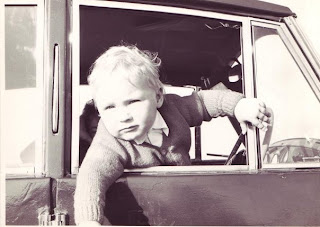
The third boy was in black and white, sitting in the back of a Ford Zephyr, only feet away from Peter, but trapped behind an impenetrable wall of deafening silence, separated by forty years of sorrow.
 
All he’d wanted to do was to get a bit closer to the hovercraft. He’d never even seen a hovercraft before, let alone been so close to one. All that separated him from this magnificent beached sea monster was a flimsy metal railing that surely could not contain the snorting beast. He screamed to his father to hold his hand and take him nearer, but he couldn’t be heard above the incredible roar of the engines, the air blasting sea water onto the coarse pebble beach and the cacophonous screeching of displaced seagulls. He wanted to get as close as he could; to feel the salty spray on his face, hear the pebbles ricochet off the barriers with the sound that the bullets made in the black and white westerns he watched on TV; to wave to the people trapped in the glass belly of this man made leviathan. But he wanted to do it with his hand clasped firmly in his father’s; to be able to hide in the folds of his father’s coat if the monster spat its lethal venom at him; to blanket himself in the security of his father, yet still experience the thrill of being so close up to danger.

How could his father have missed the point so badly when he’d shouted above the din: “Come on, let’s get you away from all this noise. The football results will be on the radio in a minute.” Why did his father not know what he wanted? Why did he always miss the point? Other kids’ dads got it. Why not his?

And to compound everything, his father bestowed on him the so-called treat that came the way of all seventies’ kids at the end of a family trip to the pub or the seaside: a bottle of Coke and a packet of crisps in the back of the car, to be enjoyed in silence, face trying desperately not to slump in disappointment.

Back in the warmth of the vehicle, away from the deadly pebbles and ferocious sea creatures, his mother’s ever present cigarette smoke billowed up a thick fog of fug between the boy and his parents. His mother and father, as was most often the case, sat in stony silence, with nothing to say to each other and no parental wisdom to impart to him. Just smoking and staring into space; a lifetime of smoking and staring.

The hovercraft’s noise had abated enough for the child to hear James Alexander Gordon intone, “Portsmouth one, Carlisle United” (and you could always tell from his inflexion that an away win was coming) “…four.”

“Bloody rubbish”, the boy’s father said for the umpteenth Saturday, and started the car. As the Zephyr jerked away, the Coke bottle banged sharply against the child’s front teeth, spilling the flat, brown liquid down his tank top, and another crushing childhood episode drew to a close.
 
Peter took the fiver back and opened his door. “Come on boys,” he said, “let’s do this together.”
 
As the three of them climbed out of the car and ran hungrily, hand in hand, towards the ice cream parlour, a modern, sleek looking hovercraft glided in near silence up the slipway, barely raising the noise level above that of the general promenade hubbub, almost hidden from sight by the recently installed safety screens.

At the same time, and yet forty years earlier, a monochrome boy in a black and white tank top looked out of a car window, cracked a cold sore smile in the knowledge that history wasn’t repeating itself, and split open a bag of crisps.